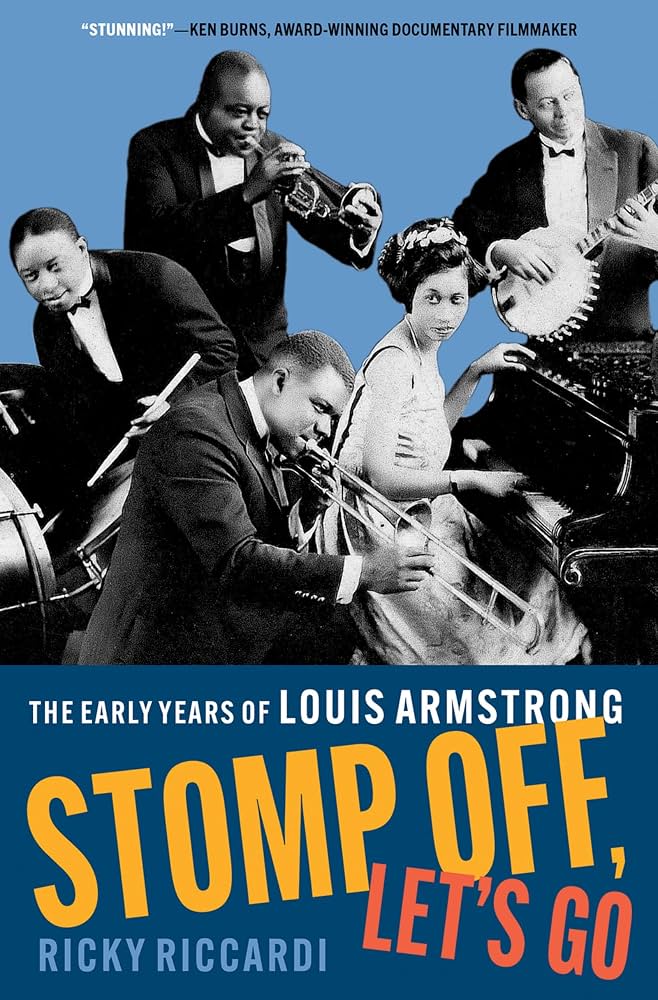
Jazz88’s Peter Solomon speaks with Ricky Riccardi, the Head of Research Collections at the Louis Armstrong House Museum, and the author of three books on Armstrong. Riccardi’s newest book is called “Stomp Off, Let’s Go: The Early Years of Louis Armstrong.” It draws on previously unavailable sources to provide new details and insights about Armstrong’s life and music, particularly shedding light on his early years in New Orleans. The book is set to be released in audio book form on Augist 26th.
TRANSCRIPT:
RICKY RICCARDI: Hi. My name is Ricky Riccardi. I am Director of Research Collections for the Louis Armstrong House Museum, which means I’m in charge of the world’s largest archives for any single jazz musician. And on top of that, I’ve written three books on Armstrong, the latest being, Stomp Off, Let’s Go: The Early Years of Louis Armstrong. I teach Armstrong courses. I’ve won two Grammy Awards for writing Armstrong liner notes. To put it simply, I’m all Armstrong all the time.
PETER SOLOMON: There are, of course, many existing books on Louis Armstrong, including a famous autobiography telling his backstory in New Orleans. What made you want to write Stomp Off, Let’s Go?
RICCARDI: Well, at first I didn’t want to write because I got into Armstrong through the music he made in the 1950s and when I was first discovering him, there was this kind of narrative that Armstrong was a genius in the 1920s and then he kind of sold out in 1929 began recording love songs and pop tunes and making movies and going on Ed Sullivan and then singing “Hello Dolly.” And by the end of his career, he was kind of a joke, and I was in high school, and I never believed that. So, I wrote one book in 2011 called, What a Wonderful World, The Magic of Louis Armstrong’s Later Years. That’s the story from 1947 to his passing. And then in 2020 I wrote a book called Heart Full of Rhythm: The Big Band Years of Louis Armstrong. So, I had kind of looked at those critics in the eye and said, “All right, you know, you think the story ends in 1929. Well, my story begins in 1929,” and so I’ve done my job. I’ve spent, you know, almost 30 years kind of reframing and reshaping and kind of addressing some of the mythology and kind of wrongheaded assumptions about more than half of Armstrong’s career. So that just left this one big blind spot in my personal trilogy. And at first, I was like, well, Louis did the best job. You know, he wrote his own book Satchmo: My Life in New Orleans. But then, you know, Lawrence Bergman, Terry Teachout, Thomas Brothers… There have been all these books, all these authors, and all those books are very strong on the early years and how great “West End blues” is and how influential the Hot Five is. And it’s like, well, what more can I add? And then I looked around and I realized by doing it in reverse chronology, I had waited and kind of ran out the clock, and just in the last ten years alone, so many new sources have come to light. At the Armstrong house, we received the complete unedited manuscript for Satchmo: My Life in New Orleans as typed by Louis Armstrong. I received access to interviews with Louis’ sister, Beatrice that had never been published. Lil Hardin, Louis’ second wife, she was working on an autobiography that was presumed lost. And then in this crazy digitized world we live in, all of a sudden, newspapers, ancestry.com, police records, interviews at Tulane University, interviews that the late Phil Schaap did. All this stuff became available just in the last five or ten years.
Here and there, and it was when I started putting the research together. I said, “Oh, my goodness, I can tell this story and not even have to crack open any of those other biographies.” You know, I could just let the people who were there tell the story, unpublished variations, new research, you know. And now I have to admit, the book that I didn’t want to write, I might be right now, probably prouder of this one than the other ones. So, you know, it all worked out. In the end.
SOLOMON: I thought that there was a lot of new insights in this book, and one of the striking things are the details that you fill in, particularly about Louis’ childhood in New Orleans, what it was actually like for him. His mom was known to have a substance abuse problem, but you know, as you talked about in in his book, in your book, rather, she would be around for a little while, and then she’d go off to jail or go on a bender for several weeks at a time. And you really explore how this affected Louis. And the striking thing to me is the difference in tone between your book and the positive spin that he puts on his childhood in Satchmo life in New Orleans. And I was wondering if you could kind of talk about some of those differences that came up.
RICCARDI: I kind of use Satchmo: My Life in New Orleans as a guide. This book. Stomp off. Let’s Go, It’s not a complete annotated version of Satchmo, but at times it felt like that’s what I was writing. There’s the published version. Then, like I said, we got access to this manuscript.
So I would go through the manuscript, and he would say that my mother, whether or not my mother did any hustling, as he put it, you know, was a sex worker. You know, I cannot say, you know. Well, I go on ancestry.com, I search for his mother by her maiden name, Mary Albert. And there she is arrested in 1905 and 1909, 1912… multiple arrests over the years, and almost every time, occupation: prostitute, drinking, disturbing the peace. And, you know, again, he mentions that sometimes my mom would leave, and we would stay with my uncle, Ike. Well, yeah, she was leaving because she was going to jail. And then Armstrong, you know, needing to start working at sometimes at seven, eight years old, cooking for his baby sister. It was definitely more harrowing than he described, because he tells every story he always finds a positive spin, but at the same time, you know, I didn’t want to lose the importance of these people in his life, so I didn’t want to paint a tragedy. That was probably the hardest part, was kind of trying to find the right tone, just letting my readers know this was a scary upbringing. You know, this kid was basically an unsupervised street urchin, dodging the police, not knowing where his next meal was coming from, barely going to school, trying to make ends meet, living alone, taking care of his sister, just trying to survive. Yet he had this community. You know, his mother did teach him how to treat people and how to respect people. And he had, you know, these larger than life, colorful characters, Black Benny Williams and Slippers, the bouncer and musicians, of course, like Joe Oliver, who would take the time, and those are the people that he really devoted Satchmo: My Life In New Orleans to. Some people read that book, and they kind of get frustrated that there’s not so much about the music. But I think that was his point. He wanted it to be about the community. He wanted to kind of make these people who helped him, who guided him through he wanted to make sure they wouldn’t be forgotten. So it was trying to strike that balance of this was a scary time, but he had enough light and enough positive influence to guide him through it and really turn him into the human being and the humanitarian he became, because anybody else could have grown out of that and been justifiably bitter and angry for the rest of their life. But Louis, you know, he realized that people took a chance on him, they believed in him and for the rest of his life. You know, his fans, his public or anybody who had a moment in his presence, he was going to treat them with respect and, you know, really give them his best, because that’s how he was treated as a young man.
SOLOMON: This year, there’s a piano player named Cailie O’Doherty, within the past year that released an album exploring the compositions of Lil Hardin Armstrong. And she had a career after she was married to Louis. She died very shortly after he did. And I feel like she’s a bit a little bit neglected by history, but you really explore the ways that she affected Louis’ career. Now, they met while they were both playing in King Oliver’s Creole Jazz Orchestra in Chicago around what 1922 or so. Can you talk about that relationship and the way that she kind of put Louis on the path to becoming a successful solo artist?
RICCARDI: For sure, if there’s no Lil Hardin, I don’t know if we’re having this conversation right now, Because Satchmo: My Life In New Orleans ends with Louis joining King Oliver in Chicago. And I honestly believe to him, that was the climax of his life. You know, he had survived those years in New Orleans. He’s in Chicago. He’s with his heroes. It’s an all–New Orleans band. He’s with his mentor, father figure. He would have probably stayed as a sideman in the Oliver band for years. And you know, he even said in later interviews, you know, “Oh, I wish he would have given me more solos. He could have gotten the credit and the fame. I would have done anything for Joe Oliver.” So that was Lewis’s mindset. It was never about, I’m going to be the towering influence of the 20th century, and I’m going to be this influence. And the greatest trumpeter, Lil was the one who kind of engineered all that. I always say she’s the architect of his stardom. They begin dating in 1923 she hears him whistling, tells him, write that down, copyright it, send it to the Library of Congress. That’s a song that’s great. If only you played like that after they get married. Joe Oliver has already hinted to Lil that, you know, he’s kind of holding Louie back, and so she delivers the ultimatum. “You know, you’re quitting Joe Oliver.”
And so, he does that, and then now he’s scuffling in Chicago, and he can’t find work, and people are turning him down, and she’s his biggest cheerleader. “Oh, don’t worry, they’ll be eating at your feet, you know, you’ll just keep going.” You know, he gets the job in New York. But then she goes to New York and realizes that Fletcher Henderson won’t let him sing, and he’s not really publicizing Armstrong’s role in the band. So she makes him come back to Chicago, join her band, bills him as the world’s greatest cornet, gets him more money than he was making in New York, calls the record label and tells him that Louis is coming back, you know, we should record him, which leads to the hot five recordings. And then, you know, gets a home while he’s in New York, and fixes the home up, has a piano in there. They have rehearsals for the hot five sessions. She’s still writing tunes, “Struttin’ with Some Barbecue,” this and that. And, you know, Louis was kind of old fashioned in his way, so he didn’t want his wife working. So, you know, Lil basically, kind of puts her musical career on pause. And as you mentioned, she, you know, they separate in ‘31 and divorce and ’38. She continues writing songs. She records for Decca, she records for Riverside in 1961 she goes to Paris in the 1950s but never got the credit she deserved on her own, her own piano playing. I mean, there’s some King Oliver sides where she takes some fantastic solos,
Her compositions are now rightfully being discovered, especially by the young generation. Cailee O’Doherty was one of my students at Queens College, and I was there, I saw the moment that she kind of discovered Lil and was like, “Tell me more about this person.” So, people are discovering that, but really her role in Louis’ saga. People kind of knew that she was there and made him quit King Oliver. But, you know, I was able to find it direct from the source, from unpublished interviews and her attempted autobiography that she knew that this was kind of one of her personality traits. She liked to kind of shape people and give them a push and give them a boost. And Louis was her greatest project when it came to that. And you know, the rest of the world’s been benefiting for over 100 years. But who knows the shape jazz would would have become without Lil giving him that push?
SOLOMON: One of the things that you alluded to a few minutes ago when you were talking about the way that critics have treated Armstrong’s music from the 20s versus later in his career, was they kind of elevate their music and apply their own ideas of what made him great, but in a way, they provide a narrow and somewhat slanted view, and they disregard aspects of his personality that you kind of bring to light that were always present. And I’m thinking about the dancing and the joking aspects of his art, his role as a comedian. And it’s not like these hot five and hot seven sides were devoid of any kind of humor. Could you talk about how that aspect is always present in his work?
RICCARDI: For the longest time, you know the narrative was the music he made in the 20s, was the music of a serious artist. When you hear instrumentals like “Cornet Chop Suey” and Potato Head Blues,” when you hear the cadenza and “West End Blues,” that is art, that is innovation, and that does not bear a trace to the later guy singing, “Hello Dolly” and “What a Wonderful World” and all this kind of stuff. And so, the easy way out for those earlier critics and biographers was just to make the claim that Louis sold out. You know, in 1929 they dangled some money in front of him. They said, “You know, if you do some love songs and things like that and smile more and joke around. You know, you can make some money”. And so, he said, “All right.” And he traded in the artistry to become an entertainer and a showman. And that gave critics’ 50, 60, years to opine about and write about, and poor Louis Armstrong. And so, by doing the books in reverse order, I had all these stories Louis’ sister and the musicians, people in the Waif’s Home, and people who remembered him as a kid, as a teenager, on the river boats. And what is he doing? He’s doing Bert Williams routines. He’s impersonating a preacher. He’s singing. He’s scatting, he’s dancing. He’s doing comedy numbers. He’s doing minstrel numbers. He’s doing, you know, I quote Johnny St. Cyr and Kid Ory how all those New Orleans bands would play the latest popular music. He goes on the river boats, and he’s playing waltzes and show tunes and things like that. And then through the 1920s Yes, I will never say anything to tear down the hot five and the hot seven. Those recordings are unimpeachable in terms of their influence on everything that followed. Yeah, but those were studio groups, and you know, on a nightly basis, once I was able to access Armstrong’s scrapbooks that he kept in the 1920s there’s the black press almost every time. Yes, you know, they know he’s a great trumpeter, but they’re praising him for the showmanship. They’re praising him for the comedy. And the latest routine he did was drummer Zutty Singleton wearing a dress, and Louies singing to, “Oh my god!” the audience was screaming, you know. And his features, he’s doing “Cavalleria Rusticana.” He’s doing Noel Coward’s “Poor Little Rich Girl.” He’s doing songs that Paul Whiteman was recording, Guy Lombardo was recording, and all that is at the same time as the hot five recordings. And then, as you alluded to, if you listen to the complete hot fives, you get Louis playing slide whistle on “Who’s It?” You get the chitlin rag monolog on “King of the Zulus” and the square dance parody on “Big Fat Ma and Skinny Pa.” And, you know, there’s all this personality just kind of oozing out of those grooves.
So, I think that was the big takeaway, is that there’s a consistency in Louis’ career. Yes, if you play “West End Blues” and follow it immediately with “Hello Dolly,’ you can say Aha. You know, something’s different there. What changed? But if you just take it from the teens through the end of his life, LOUIS is always in touch with whatever the popular sounds are. He’s always adapting it to his personal style, and he always finds a role for comedy, for showmanship. It’s there for black audiences in Chicago. It’s there for the street audiences in New Orleans. It’s there for all audiences around the world. As Ambassador Satch for the rest of his life, those musical values that were instilled in him when he was a teenager are still his musical values. In the 60s, things changed. He changed. He matured. His styles changed, life changes. But at the same time, what he was hooked on, melodies, lyricism, tone, you know, all that kind of stuff, singing from the heart, playing from the heart, that’s there in every decade of his career.
SOLOMON: I’ve read that Armstrong would have good things to say about his manager, Joe Glaser, in public, but in private, he thought of him as a kind of necessary evil. And I was wondering if you could comment based on the archives that you’ve seen on that, and also the idea of Armstrong, the public persona, versus Armstrong in private. And what you see the differences are,
RICCARDI: Well, the Glazer thing is definitely it’s a hard subject to pin down, because on the surface, it’s almost too simplistic, rough talking Chicago gangster becomes a manager and a millionaire off the talent and hard work of an African American genius who’s out there playing high school gymnasiums 300 days a year, you know, getting heart attacks and busting his lip and all that kind of stuff. So, the Armstrong Glazer relationship has always rubbed people the wrong way, and I totally understand that, but you use the phrase “necessary evil.” I think necessary evil is what we in the 21st Century would call it. I don’t think Louis would call it that. I think he would say it was necessary period. Because growing up in New Orleans, Louis got advice from older black friends who told him go up North find a white man who’s always going to put his hand on his shoulder and say, “You know, that’s my N word.” And people, to this day, they hear that story. Louis would tell it on TV, and people wince, and they go, “Oh, my God,” but Louis, he told that story because it was the truth. You know, he had been arrested. He had had bad managers. He had, you know, been thrown in jail and had no one to call. And all of a sudden, he had protection. You know, the manager he had before, Joe Glaser. I mean, Louis was held at gunpoint. He had to escape the mob, he had to go down south, he had to go overseas. Then that manager called him the N word and took his passport. And you know, Louis came back with no lip and no gigs and no money and no band. This is like 1935 and this is all covered in my previous book, and it was like rock bottom. And then he said, “You know, if you’re gonna have to play ball with a gangster, you need a gangster yourself.” So, he is the one who called Joe Glaser and said, “Do what you want with the money. You pay me $1,000 a week, take care of my bills, my expenses. You know, you keep the rest. I just want protection.’ Yeah, and from 1935 until Glazer died in 69 Armstrong never had to worry about anything else, except for playing the horn and anytime he did feel like Glazer was maybe pocketing too much or wasn’t paying out. Multiple people told me multiple stories about Louis calling him up and telling him off. He was not afraid of him. He was not subservient. He knew he was the boss,
I think this, the current book I wrote, kind of gets into the details of the street-smart Louis Armstrong. You know the guy who tried being a pimp for a minute, the guy who had to navigate the racist police and the audiences on the river boat. So, Louis was not a dummy. He was very smart. He knew how society worked. He knew what he needed to do to survive. He wasn’t just going to roll over and do anything. And so for all of the flaws of the relationship and for all of Glazer’s flaws as a human being, both men ended up millionaires, and when both men were dead, Lucille Armstrong was asked about that point blank in her widowhood, Lucille was the fourth and final Mrs. Armstrong, did Joe Glaser steal? and what do you think? And she just brushed it off and said, “Listen, you know, he died a millionaire. Louis died a millionaire. And I could say this now he was probably the closest friend Louie had.” And we do have stuff after Glazer died, where Louis in his scrapbooks pasted in pictures of Glazer and wrote “My manager and my best friend.” So, when I tell this story, I always have to make sure people know I’m not elevating Glazer into hero status or anything like that. Glazer, oh my god, again. My last book covers his pre-Louis life and it is pretty sordid. But to get back to Armstrong, as I mentioned, this kind of street smart, no nonsense tough guy, that is not the Louis Armstrong that you would see on the Johnny Carson Show or the Ed Sullivan Show, but that is the Louis Armstrong that he preserved for his archive.
So, you know, we have about 750 reel to reel tapes. He bought his first tape recorder in 1950, and he made hundreds of tapes right up till the day before he died, and those tapes are at the center of all my research. And after listening to all the tapes, the one thing that strikes me is there’s no difference. You know, on most of the tapes, what you see is what you get. You know, on those tapes, he is the most gregarious, approachable, funny, laughing the loudest, telling the dirtiest jokes. We have tapes of him interacting with fans and flirting with his wife and just, you know, everything you’d want him to be. But then there are tapes where he is venting about racism, and he is cursing. Tapes where he gets in an argument with his wife and they’re going at it, and he wanted, I think, to make sure all that was preserved too, the tape where he gets in the argument with his wife, Lucille, she doesn’t know he’s taping it, and when she discovers that, she tells him to erase it, and he goes, No, that’s for posterity.
So, I do feel like he was playing the long game that the way people were perceiving him in his lifetime, he couldn’t really do anything about that, especially as probably the most famous black entertainer at the time. But by making these tapes and leaving these scrapbooks and collages and all that kind of stuff, he would leave it to future generations. Yeah, he told Glaser at one point, “They’re gonna write about me in the history books someday.” And sure enough, when he died in ‘71 it was the passing of this great entertainer, and everybody loved him, and loved “Hello, Dolly.” Now you know, people talk about Armstrong the artist, and Armstrong the innovator, Armstrong the Civil Rights pioneer, and you have the documentary Louis Armstrong Black and Blues that came out a few years ago, rated R that used all of his tapes and, you know, the books and different ways of looking at him. You know, he’s become, I think, a fully dimensional, you know, interdisciplinary, multi-dimensional, I should say, artist. And none of that would have been possible without him leaving behind his own archives.